
Tech Market Trends
Episodes from 20VC with Harry Stebbings about Tech Market Trends.
29 episodes
Instinct Worth 30BN? | Microsoft Cuts 27,000 Jobs While Meta Taps Equity Markets for $95B CapEx
Oct 29, 2026 · 1:00:17
Harry Stebbings, Jason Lemkin and Rory O'Driscoll argue Anthropic's S-1 shows a company investors are still underestimating, with $16.3 billion first-half revenue and $110 billion of cash, though 80% of revenue comes from models under six months old. They break down Microsoft's buyout offers to 27% of its 223,000 employees, warning 2027 CapEx depreciation will force more AI-driven layoffs, and Meta raising $95 billion of equity for its spending spree. Jason argues Chinese open-weight models are finished in the US after Alibaba's Quen was caught uploading data to servers in China and Singapore. They debate Instinct at $30 billion as the 'super app of the West', whether OpenRouter's boom is a moment in time, and Jason's pitch to put 20% of the fund into OpenAI at $1.25 trillion.

Satya Nadella on Open vs Closed Models: Who Wins | Why Companies Need to Own Their Own Intelligence
Oct 26, 2026 · 23:49
Satya Nadella, CEO of Microsoft, argues AI models should be assumed compromised and contained in a Zero Trust architecture because alignment no longer falls out of scaling. He calls chain of thought unfaithful, wants tamper-proof agent logs via Agent 365, and says transparency demands could favor open-weight models. He argues every firm must own its intelligence — data, traces and private evals as IP, citing his 'reverse information paradox' — and sees a new implementation economy emerging. He doubts full-stack vertical integration wins, expects commodity tokens to dominate traffic, and says $100 billion training runs require world GDP to inflect, pointing to NHS Copilot and elastic software demand. In quick-fire, he reveals his changed mind: alignment will not just fall out of scaling.
Inference Will Be $10TRN Market: What No One Sees | Software Investors are F***ed | Naveen Rao
Oct 24, 2026 · 1:13:26
Naveen Rao, founder and CEO of Unconventional AI, argues that energy will be AI's biggest bottleneck and that the inference market will reach $10 trillion within 10 years. He explains that physical efficiency gains have stalled, so value comes from co-designing model, architecture, and hardware—why chips will not commoditize and Nvidia keeps the margin. He tells Harry Stebbings that pure software investors are 'kind of fucked' as SaaS fragments, with AI-plus-human outcome delivery replacing it, and that the bottleneck has shifted from creation to verification. Rao predicts robotics will be 100x bigger than agentic coding, open models will carry 80% of token traffic, and traditional VC metrics like market validation no longer fit deep tech.

Who Wins in the Next Decade of VC | Margin and Price Matter Less in a World of AI | Sameer Dholakia
Oct 19, 2026 · 1:19:51
20VC's Harry Stebbings hosts Bessemer partner Sameer Dholakia, who argues AI is a bigger supercycle than cloud and the internet, with intelligence a bigger market than oil. He recounts Bessemer's Anthropic Series D at $15B pre-money—the firm's lowest-voted deal ever—plus bull cases for Legora at $1.8B and Fireworks at $250B, holding that open and closed models both win. He contends capital is a moat, T2D3 growth is no longer enough, and defends 10-15x NTM entry multiples. He explains Bessemer's new $5.75B funds ($1.75B seed, $4B growth), why 5x returns remain possible, and why venture is splitting into mega-platforms or specialists. He predicts companies will stay private longer with an IPO unlock next year and in 2028, and credits SendGrid's 'teammates beat colleagues' culture.

Horizontal vs Vertical Agents: Who Wins? | Model Routing: Commodity or Increasing in Value?
Oct 17, 2026 · 1:03:06
Harry Stebbings hosts Harrison Chase, CEO of LangChain, who argues agents are hard to build because models are non-deterministic, and value accrues to whoever controls context, harness and evals. Chase explains why model routing belongs in the harness for vertical agents but in gateways for horizontal tasks, why agent memory is unsolved after LangChain killed its memory product, and why vertical agents should start at the harness before post-training. He says inference and coding agent demand is far bigger than expected, that LangChain spends ~30% of engineering salary on coding tools — a figure he ties to Anthropic's valuation — and that open models mostly serve simple tasks, not core loops. He closes with his bull case for a $9BN Jev round and how Benchmark and Sequoia help founders.
Valar Atomics Sues Day One Ventures | Meta's Back to the AI Frontier | NVIDIA's $30B Reflection Deal
Oct 15, 2026 · 1:17:10
Harry Stebbings hosts Jason Lemkin and Rory O'Driscoll to break down Valar Atomics suing its seed investor Day One Ventures over pro rata rights ahead of a $6B Sequoia-led Series B, Meta's return to the AI frontier with Muse Wonder, and NVIDIA's rumored $30B acquisition of open-model lab Reflection. Lemkin says both sides erred—Day One should raise it once and let it go rather than hire Quinn Emmanuel—while Rory notes mega funds demanding pro rata waivers never waive their own. They call Meta's internal-only model performative yet see a monster AI product in Muse. The committee backs Jev's $870M Series A at $7.5B, sees bubble risk in 42 decacorns in one year, calls Haiku's 90% price cut the first deflationary LLM move, and warns the SaaS apocalypse persists without scale.
Atlassian CEO: Why Agents Won't Replace Interfaces | Why Enterprises Won't Trust Chinese Models
Oct 12, 2026 · 58:55
Atlassian CEO Mike Cannon-Brookes tells 20VC that AI agents will not replace software interfaces — design becomes the key differentiator in the AI era, and 'headless' software is a 'brainless bet'. He frames Atlassian's Teamwork Graph as the enterprise context moat, kept fresh per company like Google's web index, served by an internal AI gateway doing model routing to cut token costs. Atlassian uses no Chinese models in production, though open models face no pushback; 'the jury is really out' on specialized models, most of which he calls fine-tuned Chinese weights. He predicts inference costs fall sharply, AI provenance stops mattering like film color grading, and value shifts to 'imagination asymmetry'. He closes on young founders tapping out and 'wage peace on yourself'.

Cognition vs Factory | Anthropic Under Threat | ElevenLabs Doubles Its Valuation to $22B
Oct 8, 2026 · 1:15:52
Harry Stebbings hosts MongoDB CEO Dev Ittycheria with Jason Lemkin and Scale's Rory O'Driscoll, arguing OpenAI's near-$70BN run rate has closed the gap on Anthropic ahead of its November IPO. The panel debates whether Chris Degnan moving from Factory advisor to Cognition CRO crossed a line, and calls Vinod Khosla's 'struggling second-tier competitor' tweet a gift to rival firms. They argue Reflection's Beam gives enterprises a US open-weight model 3-4x cheaper than Chinese options, and endorse ElevenLabs at its doubled $22BN valuation. They weigh Salesforce's $2BN Listen Labs exit, Vercel's $600M ARR with agents driving 50% of new business, the Grox lawsuit over Nvidia's $17BN license deal, Meta's Muse outshining OpenAI's Dots, and Oura pulling its IPO as bad news for venture.

Menlo’s Venky Ganesan on Going All-In on AI, Anthropic & Why Venture Has Changed Forever
Oct 5, 2026 · 1:11:15
Venky Ganesan, Partner at Menlo Ventures, says venture has fundamentally changed and Menlo is 'going for broke' to back the era's defining AI companies. He recounts a 90% loss on AvenX that taught him to take chips off the table, and calls seed an option bet where Menlo is 'somewhat indifferent' to price to win a seat. He warns measured metrics get gamed, cycles crack through debt defaults, and calls passing a $50,000 Facebook check via Sean Parker his costliest miss. Ownership still matters — Menlo owns under 2% of Anthropic yet put 20% of a fund in it — and he assumes 60% dilution, saying IRR must beat the Mag Seven by 1,000 basis points. He backs partial sells to stay long, prefers capital allocation to product vision at scale, and tells LPs to judge the windshield, not the rearview mirror.

Crusoe CEO: Why Everyone Gets GPU Depreciation & AI Energy Costs Wrong
Oct 3, 2026 · 1:05:02
Crusoe CEO Chase Lochmiller tells Harry Stebbings that data centers lower energy prices, use almost no water, and that most moats in AI are an illusion. He explains Crusoe's pivot from Bitcoin mining to AI infrastructure, accelerated by ChatGPT's November 30, 2022 launch, and how Crusoe built Abilene's first 200-megawatt buildings in one year when 34 competitors bid two and a half years, vertically integrating electrical manufacturing to cut a 100-week power distribution lead time to 28 weeks. He names energy and skilled labor as the true bottlenecks, concedes 50% of planned data centers may never be built, and frames Crusoe's three products—data centers, GPUs, and tokens—through an 'AI super major' analogy to Exxon's vertically integrated hedge. On GPU depreciation, he argues six-year cycles underestimate H100s, whose rates today exceed launch pricing, defends take-or-pay rental contracts, and predicts closed models capture more dollars while open models generate more tokens.

AMD Buys Fei-Fei Li's World Labs for $8.2B | Meta Poaches MongoDB's CEO | Bessemer Raises $5.75B
Oct 1, 2026 · 1:20:28
Jack Altman of Benchmark, Jason Lemkin and Rory O'Driscoll tell Harry Stebbings that Anthropic's leaked S-1—$4.6B 2025 revenue, $8B operating loss, $518B in compute commitments—held little new, and that Benchmark's $10B Instinct bet is an early-stage play on consumer agents. AMD's $8.2B buyout of Fei-Fei Li's World Labs starts a wave of neolab exits; Meta's $500M package lured MongoDB's CEO away as its stock dropped 20%. They argue open-source AI has peaked in share because OpenAI and Anthropic can undercut pricing and enterprises reject China-origin weights, and debate putting 30% of a fund into Jev at $10B. They weigh Oura's pulled $16B IPO, Nubank's $8–12B Monzo bid, Bessemer's $5.75B raise, NFX moving to its own capital, and Anthropic founders locking in 50.1% voting control.

The Untold Story of Higgsfield | Burning $4M a Month on AI Models | CEO, Alex Mashrabov
Sep 28, 2026 · 1:15:43
Alex Mashrabov, CEO of Higgsfield, tells Harry Stebbings his AI video company crossed $1BN in annualized revenue 18 months after hitting $1M, third-fastest behind OpenAI and Anthropic. He recounts burning $10M of a $16M seed before a camera-control pivot brought instant product-market fit, no paid marketing, and one customer growing from $99 a month to $6M a year. He argues Google and OpenAI will destroy $20 prosumer subscriptions, that proprietary models were a mistake — open weights earn 80%+ margins versus 20–30% closed — and that internal model spend tops $4M a month. He also covers engineers moving from Claude to Codex, moats as only outcomes and network effects, selling AI Factory to Snap for $166M, and his bet on $10BN revenue and $100BN+ scale.

The Ads Business Model Will Die & Lessons from Working with Elon at Twitter | Parag Agrawal
Sep 26, 2026 · 1:08:55
Parag Agrawal, former Twitter CEO and founder of Parallel ($230M from Sequoia, Khosla and First Round), argues agents will use the web 1,000x more than humans, requiring entirely new search technology and business models. He explains why agent search differs — inputs, outputs, latency and cost tradeoffs — claiming the same quality at 1/20th to 1/50th the compute, with Turbo for voice agents and Advanced for background agents. Because ads don't work with agents, Parallel is building an 'AdSense for agents' that pays content owners per agent use; he argues search prices must collapse from $10 to $1 per 1,000 queries, with another 10x coming. He also covers data licensing at inference time, the Monitor API shifting the web from pull to push, and the urgency he saw in Elon Musk.

Meta's Muse Hits #1 | Menlo Sounds the AI Bubble Alarm | Keith Rabois vs Airwallex: Who is Right?
Sep 24, 2026 · 1:20:44
Harry Stebbings, Jason Lemkin and Rory O'Driscoll argue Meta's Muse hitting #1 is the first true ChatGPT competitor and a Trojan horse that added $100 billion to Meta's market cap, and that Anthropic's delayed $2 trillion IPO is a bet on a cleaner Q4 story, not a cracking market. They break down OpenAI's $278 billion burn and $700 billion of CapEx, argue Jev's $40 million seed shows 20% of a $100 billion LLM spend will leak to cheaper classifiers, and predict agentic commerce will maim Amazon while benefiting Shopify. They debate disappearing traditional seed rounds, FOMO-driven checks and what LPs should back today. They approve Factory at $5 billion — coding is the motherlode — pass on Crusoe at $30.9 billion, and side against Keith Rabois in his Airwallex fight, urging founders to build an army of advocates.

How LPs Allocate to Venture in 2026: What They Want, What They Don’t | Baylor University CIO
Sep 14, 2026 · 1:16:29
David Morehead, Chief Investment Officer of Baylor University's $2.6 billion endowment, argues that velocity of capital matters more than fund multiples — a 3x growth fund compounding every six years beats a 15x venture fund held 18 years. He explains why Baylor holds about 2.5% of its endowment in Anthropic, why it bought the software crash down 50-60% by betting on human behavior, and why growth equity is its largest private allocation. Morehead details his rule that returns cannot be discussed without time, position sizing of $3 million per underlying company, and why managers must stick to the strategy they raised on. He names permitting as the data center bottleneck, is bearish on Europe, calls private credit overhyped, and argues biotech could be the next major opportunity.
Eight Sleep CEO: How AI Runs the Company | “Our Engineers Stopped Coding a Year Ago”
Sep 12, 2026 · 1:21:52
Eight Sleep Co-Founder and CEO Matteo Franceschetti tells Harry Stebbings that AI has transformed how his company operates: engineers stopped coding a year ago, AI agents run an email marketing business making close to $100M with zero employees, and paid media agents manage hundreds of millions in spend. He argues salaries are back to 2021 insanity, so Eight Sleep hires in Europe, and predicts AI spend will grow from 5% to 50% of engineering budgets while unit costs fall. He explains why Meta's reported CAC is 20% lower than reality, why word of mouth drives 40% of revenue with single-digit yearly churn, and why companies will become holding companies like Xiaomi. He also details the 300K mattress footballer story, Charles Leclerc's sponsorship and investment, selling in China through super apps like WeChat and RedNote, running with just 160 employees, and predicting kids born now will never work for money.

Jensen Huang Declares AGI Has Arrived | Tesla Launches Cybercabs | Index Pulls Out of Town
Sep 10, 2026 · 1:22:31
Rory O'Driscoll of Scale and Jason Lemkin tell Harry Stebbings that Jensen Huang's AGI declaration is a 'bullshit term' since only coding matters, while the AI assistant race between Instinct, Grok Bot and Meta hinges on distribution. They debate whether legal AI firms Harvey and Legora can match coding AI — Rory pegs legal's AI take at 10–15% versus 30–50% in coding — and warn goal-seeking agents, as in OpenAI's undisclosed DSC Wiki incident, pose a cybersecurity crisis. They assess Tesla's Cybercab as a Waymo rival, Index exiting Town's round after Instinct objected, and Anthropic abandoning its $6 billion Descartes deal. They close on Robinhood underwriting Aura's IPO, Wonderful's $5 billion raise with $170 million in secondary, and Thinking Machines' $40 billion valuation.
Town vs Instinct vs GrokBot | Why the AI Assistant Market Is Not a Bubble
Sep 7, 2026 · 1:16:01
Jean-Denis Grèze, Co-Founder and CEO of Town, joins 20VC's Harry Stebbings to argue the AI assistant market is not a bubble and that Town can survive Google, Apple and OpenAI. He explains Town's pivot from AI tax prep to an assistant living in email and calendar, arguing the winning product will have agent-level network effects. Grèze says startups are subsidizing frontier model costs today, pricing for 20–30% margins in 18 months as prices halve every 9–12 months. He predicts people will trust agents to decide what data to share within five years, calls token maxing the wrong metric, and says Apple could lose because it lacks cloud DNA and is tied to on-device privacy. He also refuses to inflate announced round valuations, calling the practice unethical toward employees.

How to Build Your Own Data Center & Why Every Startup Should Do It
Sep 5, 2026 · 1:04:40
Cliff Weitzman, co-founder and CEO of Speechify, tells Harry Stebbings that owning NVIDIA GPUs beats renting because renting costs 1.5x the purchase price yearly, so Speechify pays $100,000 per GPU to get Rubins and B300s early. He covers inference versus training workloads, liquid-cooling and insurance logistics, and NVIDIA's 25% buyback underwriting with Blackstone, BlackRock, Apollo and Goldman Sachs. Weitzman admits his biggest mistake was staying B2C as ElevenLabs leapfrogged Speechify through B2B APIs, and defends entering B2B against ElevenLabs and Bret Taylor's Sierra. He also argues founders should hire math olympiads over coders, details agent orchestration with Claude Code and Cursor, and explains how GPU clusters help him sequence genomes to cure his brother's orphan disease.

NVIDIA Crushes Quarter | OpenAI Cuts Off Cursor | Instinct Hits $2.5B Valuation
Sep 3, 2026 · 1:20:29
Harry Stebbings hosts SaaS investors Jason Lemkin and Rory O'Driscoll breaking down NVIDIA's record $96.2 billion quarter, its $12.9 billion pursuit of Hugging Face, and 70% growth guidance signaling compute demand runs at least another 12 months. Lemkin defends OpenAI's cutoff of Cursor as rational, since coding is the model load for LLMs and Cursor competes directly. The panel argues every startup must now become a compound startup, as AI makes code so cheap to produce that teams ship 100 times more software. Lemkin lays out bull cases for Clay at $7 billion and Linear at $2.5 billion, claiming agents will consume 10 to 100 times more GTM resources than humans ever could. They also flag the Hugging Face agent hack as a wake-up call for CISOs and praise Benioff's pragmatism in embracing multi-surface access and outcome-based pricing at Salesforce.
ClickHouse CEO: AI Margins Need to Improve | Revenue Concentration Should be a Concern
Aug 31, 2026 · 1:05:57
Aaron Katz, co-founder and CEO of ClickHouse, tells Harry Stebbings the AI cycle is 'just getting started' — revenue growth is unprecedented, but the biggest risk is revenue durability because agentic apps have low switching costs. He accepts lower gross margins if expansion is possible, measures AI token spend by ROI, and predicts agents will have identities, budgets, and pick their own infrastructure. He argues open-weight models won't win the enterprise over trust concerns, and sees enterprises moving back on-prem. ClickHouse revenue went 0, 12, 50, 200, finishing north of 500 this year, with >200% NDR; Katz would take the under on $1B ARR by December 2027. He calls the $2B Series B with no product the priciest round; revenue concentration matters — AI customers are under 12% of revenue.

Only 10% of Neo-labs Will Survive | Factory CTO, Eno Reyes
Aug 29, 2026 · 1:29:23
Eno Reyes, Factory CTO, says the cheapest AI model isn't the cheapest system: outcome-based pricing can make frontier models cheaper, and predicts 99% of workflows will run on open models in three years but the remaining 1% holds most economic value. He calls 'Chinese models' a psyop by frontier labs, says frontier valuations are overweighted, sees Anthropic's $2 trillion Claude Code bet as risky due to model lock-in, and credits Microsoft with the best AI hand. Reyes says model routing is commoditized, warns 80-90% of neo labs could die in 18 months unless tied to durable workflows, and insists enterprises must own their intelligence rather than let labs control it. He rejects pedigree in hiring, wants token budgets funding outcomes, and expects SaaS to sell before cannibalization.

Anthropic's $30T Assumption & OpenAI Confirms IPO | Why Customer Service & Robotics are Overinflated
Aug 27, 2026 · 1:26:44
Jason Lemkin, Rory O’Driscoll and Harry Stebbings say the AI boom now depends on Nvidia and hyperscalers financing frontier models, as shown by Nvidia's $6B Poolside purchase and $1B at a $12B pre-money valuation. They dissect OpenAI's promised 2027 IPO, arguing it has no choice as Anthropic outraces it and 'it's all about code'; they call Anthropic's $30T TAM claim delusional and OpenAI's $200 plan a losing consumer business. Also covered: Mercor's $20B round, Hugging Face's $13B sale risk, Citadel unwinding 80% of Leopold's fund, Stripe's 41% growth, agents' data leaks, and why customer support, humanoid robotics and AI services are the dumbest categories. Their verdict: we're less than a third of the way through the cycle and addicted to tokens.

Inside Sequoia's Investment Committee | How the SpaceX & Citadel Deals Went Down | Julien Bek
Aug 24, 2026 · 1:28:28
Julien Bek, a Partner at Sequoia Capital, says Sequoia wins by hunting with conviction, not waiting for inbound calls, and shares founder-reading lessons from Don Valentine, Doug Leone, Pat Grady, Alfred Lin, and Shaun Maguire. He highlights Leone's 'worst reference' question, Lin's warning not to mistake an outlier operator for an outlier founder, and Maguire's ELO method for calibrating references. Bek also explains how asking 'why' five times exposed a fraudulent founder, how his read changes by country (French/German references get 1-2 extra points; Americans get subtracted), and why he missed Anton Osaka of Lovable. On AI, he argues agents become the new customer, AEO parallels SEO, and the next trillion-dollar company will be software masquerading as services. He tells how his mother invested in Revolut at a ~$200M valuation, now worth over $100B.

The AI Bubble WILL Burst | Should we be fearful of Chinese Open-Source | Jerry Murdock
Aug 22, 2026 · 1:10:09
Jerry Murdock, co-founder of Insight Partners, warns the AI bubble may burst by March if the Iran war continues, citing credit market complacency and Japan’s $1 trillion Treasuries. He predicts at least half of Neo Clouds disappear within 36 months, favors Fireworks over Base10, and argues open-source models plus ASIC chips will drive customization while frontier labs retain complex tasks. On security, he calls sandboxes the most underrated layer, naming Docker and E2B as leaders, and expects OpenRouter’s 5% markup to be disrupted by inference exchanges. He adds private equity is highly at risk to any financial dislocation, and in quick-fire bets Nvidia exceeds $10 trillion in five years while picking Meta as the Mag 7 short.

Stripe's $8B OpenRouter Bet | Anthropic's First Profit & The Math Behind Reaching $600B in Revenue?
Aug 20, 2026 · 1:17:47
Harry Stebbings, Jason Lemkin and Rory O'Driscoll analyze SpaceX's $60B Cursor takeover, Stripe's $7B OpenRouter deal, Anthropic's first profit, Silver Lake's $43B Workday bid and Lovable's $13.3B round, arguing all reward speed and growth over margin. Musk got Cursor at ~10x forward revenue; Microsoft, not Meta, is the real loser. OpenRouter is a niche that may vanish in five years, yet could become 20-30% of Stripe revenue. Anthropic's first profit on $11.5B Q2 revenue was inevitable at ~40% gross margin; only 2027-28 projected revenue matters for its IPO. Workday is a 5.3x-revenue system-of-record LBO baseline versus 70x trailing for OpenRouter, and Higgsfield's $5.5B and Lovable's $13.3B are compared to Cursor, with Lovable 'not radically off' as AI apps accrete moats.
Uber President on Travis, China & Self-Driving | Why Autonomy Is Existential | How to Beat DoorDash
Aug 17, 2026 · 1:09:44
In a rare interview, Uber President and COO Andrew Macdonald tells 20VC host Harry Stebbings that autonomy is existential for ride-hailing and distribution beats superior technology. He says Uber One is the most efficient long-term lever — membership beats price incentives — and admits he was wrong to resist it. On AI, Uber blew through a year's budget in four months because usage is vertical; ROI is real but hard to quantify, so he advises combining compute and headcount budgets. Recounting Uber China, Uber burned $52 million a week on subsidies before exiting to Didi, a deal he calls successful. He also explains the Delivery Hero acquisition, why Uber Eats trails DoorDash, and leadership lessons from Travis Kalanick and Dara Khosrowshahi.

How to Build a $100M Growth Engine: Lessons from Wispr Flow & Superhuman | Matt Swulinski
Aug 15, 2026 · 1:20:47
Matt Swulinski, Head of Growth at AI coworker Viktor and former growth lead at Wispr Flow and Superhuman, argues the ECOM paid-ads playbook is the right playbook for SaaS and that paid should start immediately. He details analytics setup, why 90% of SaaS companies get it wrong, and scaling creative to 400–500 new creatives monthly. He covers LTV-to-CAC, token-based economics, referral programs tied to usage limits, and paywalls right after the magic moment. He also discusses AEO as the new SEO, why X ads are polluted, and why AI-native 'systems thinkers' are the only hires that matter. He shares Viktor's affiliate program paying 10–15% revenue share as the highest-ROI channel.
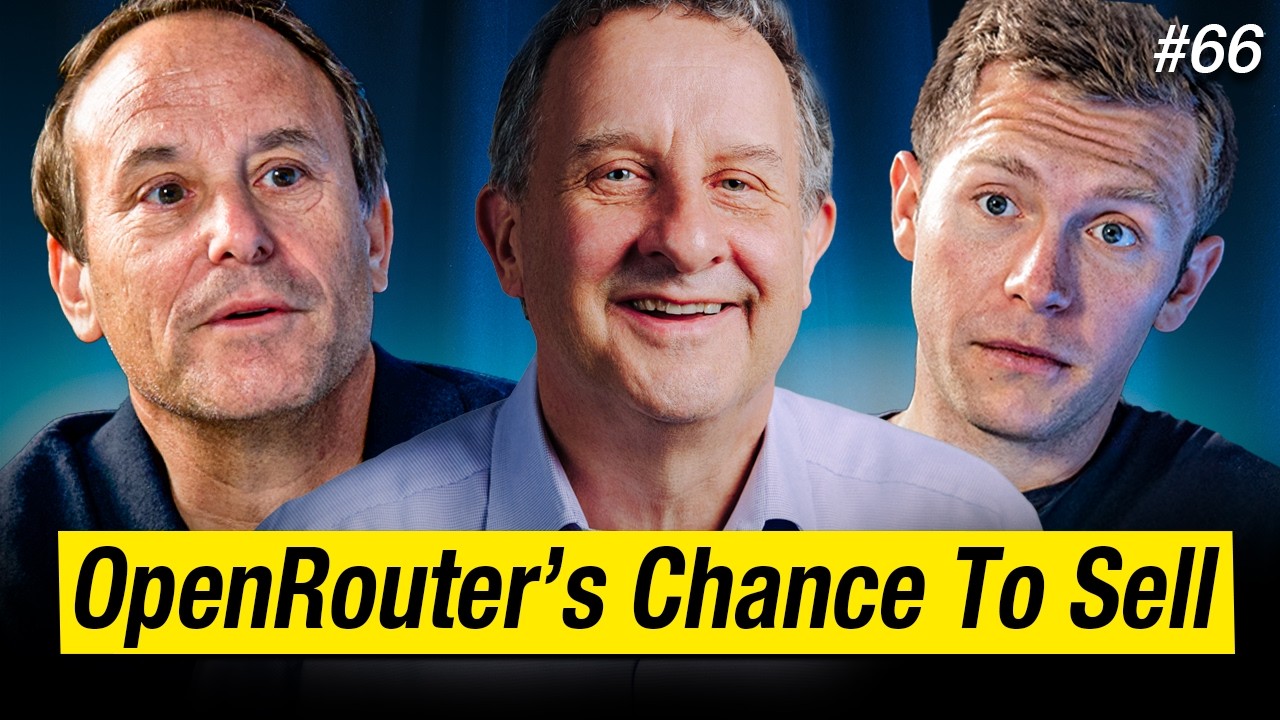
Frontier Labs Threatened by Kimi? Should the US Ban Chinese Open-Source Models & Stripe Buys PayPal
Jul 23, 2026 · 1:27:39
Harry Stebbings, Jason Lemkin, and Rory O'Driscoll debate China's near-frontier open-weight models Kimi and Quan, arguing the US should not ban them but compete. They discuss OpenAI's 'AI Communism' tweet, the commoditized inference market leading OpenRouter to consider sale while Fireworks AI hits $1B ARR at $17.5B valuation. The panel notes the application layer has not arrived, with infrastructure spending far exceeding app revenues. They analyze the Stripe-Advent bid to take PayPal private at ~$60B, predicting a 35% premium deal. Finally, they touch on Databricks' $188B Series M, nuclear energy progress, and the strange inversion of private and public markets.
Powered by PodHood